(Formerly the MRCN VX9MRC 500 kHz Experiment)
Newfoundland and Labrador, Canada
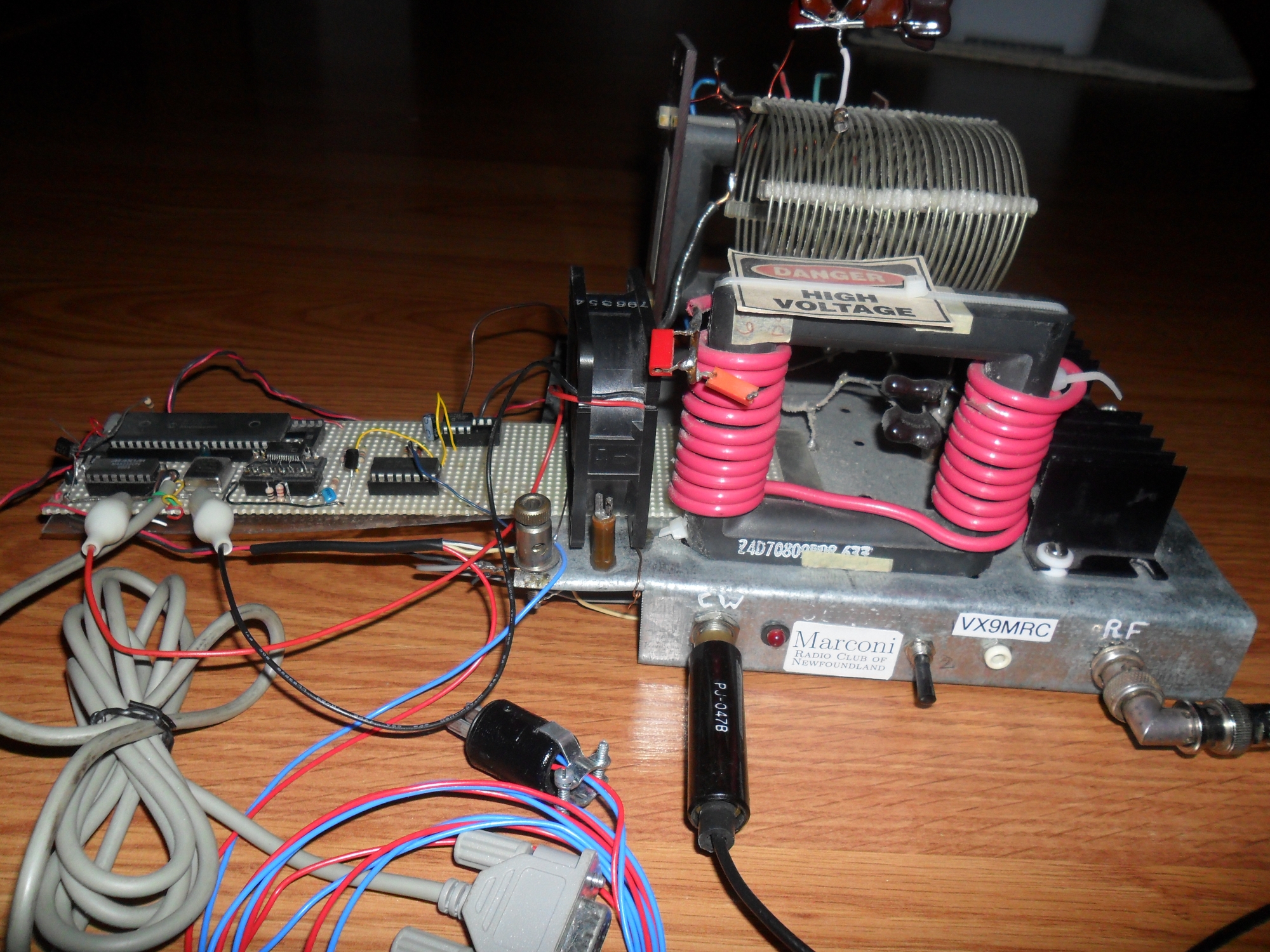
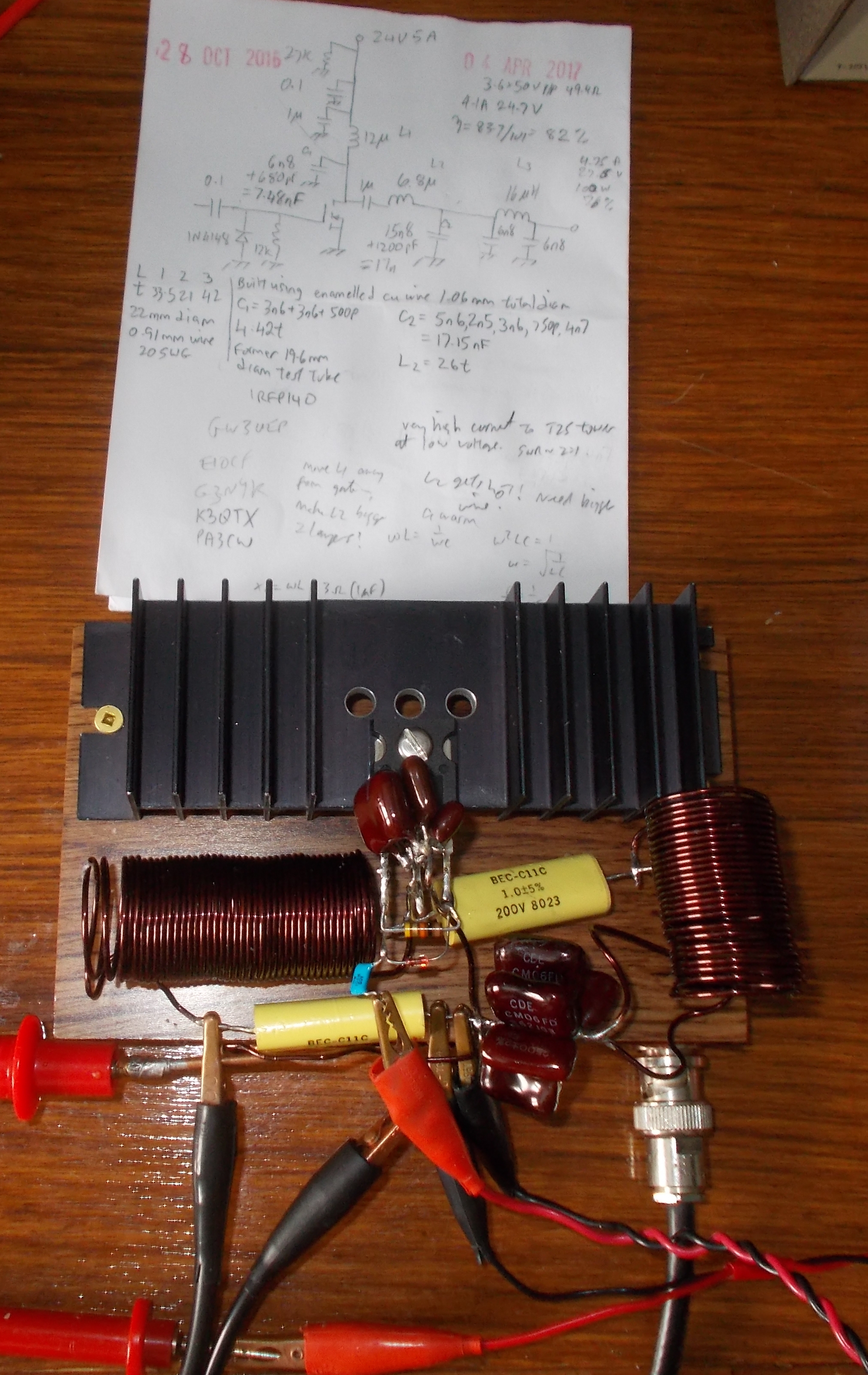
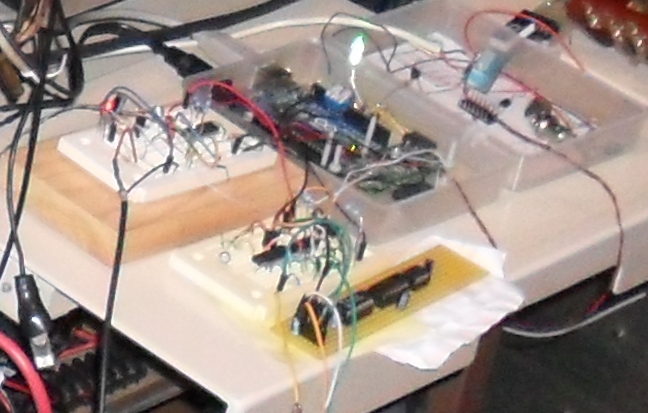
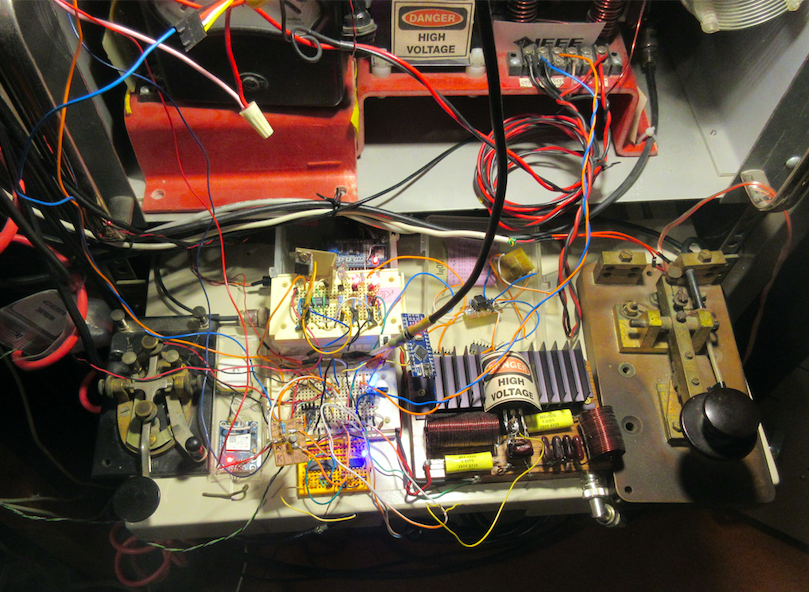 Synthesiser, keying, driver and Class E TX |
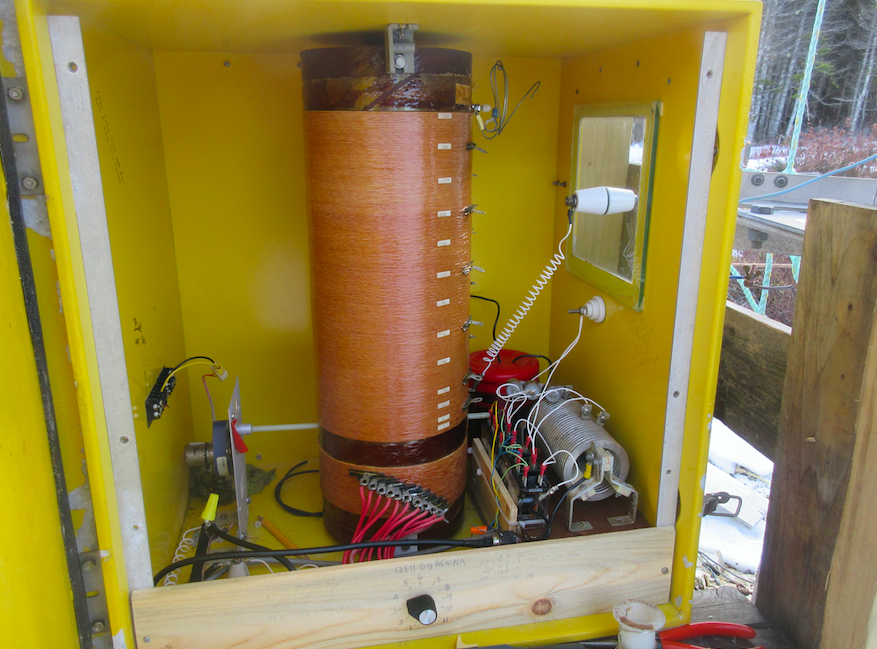 Aerial tuning 137, 475, 1830, 3530, 5360 kHz |
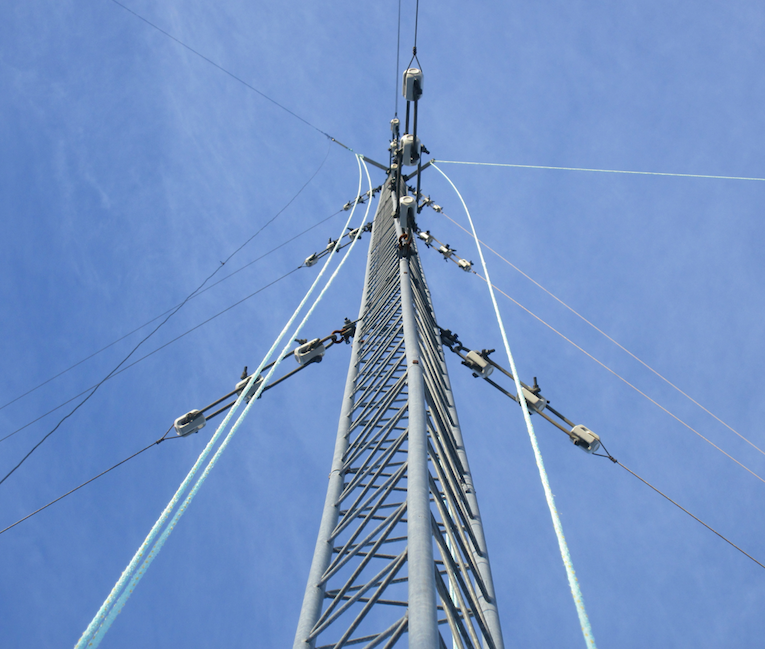 Live tower, Big RL (left) and VLF aerial (right) |
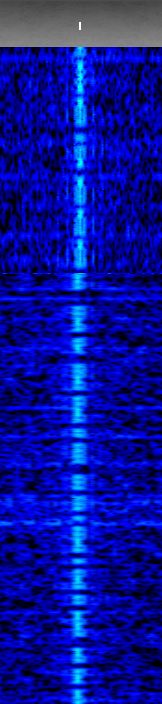
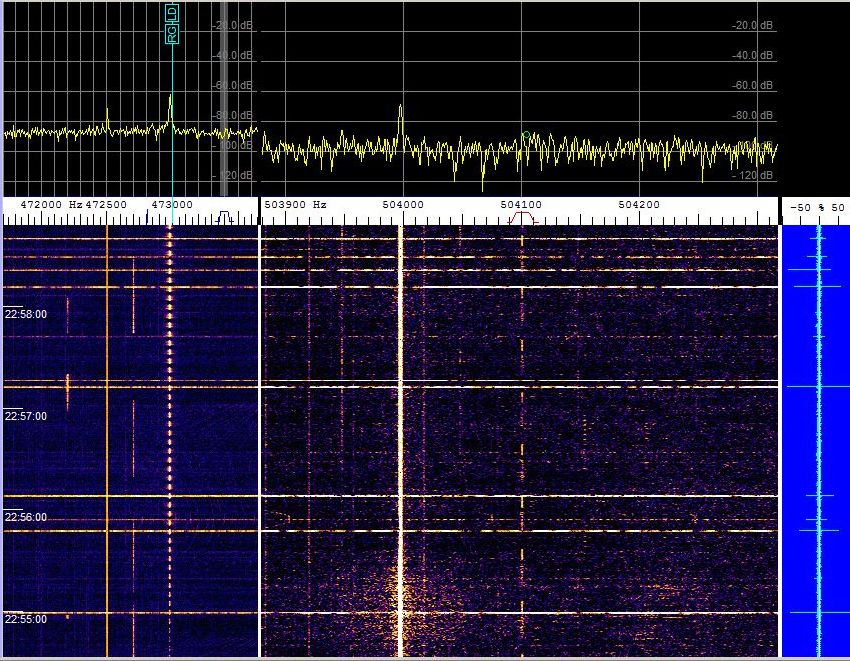
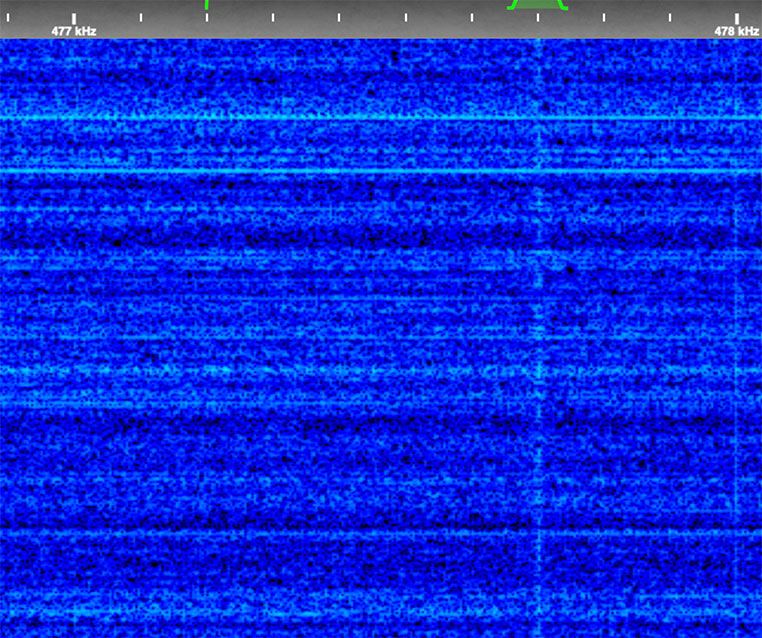 Marks grab from the 5th.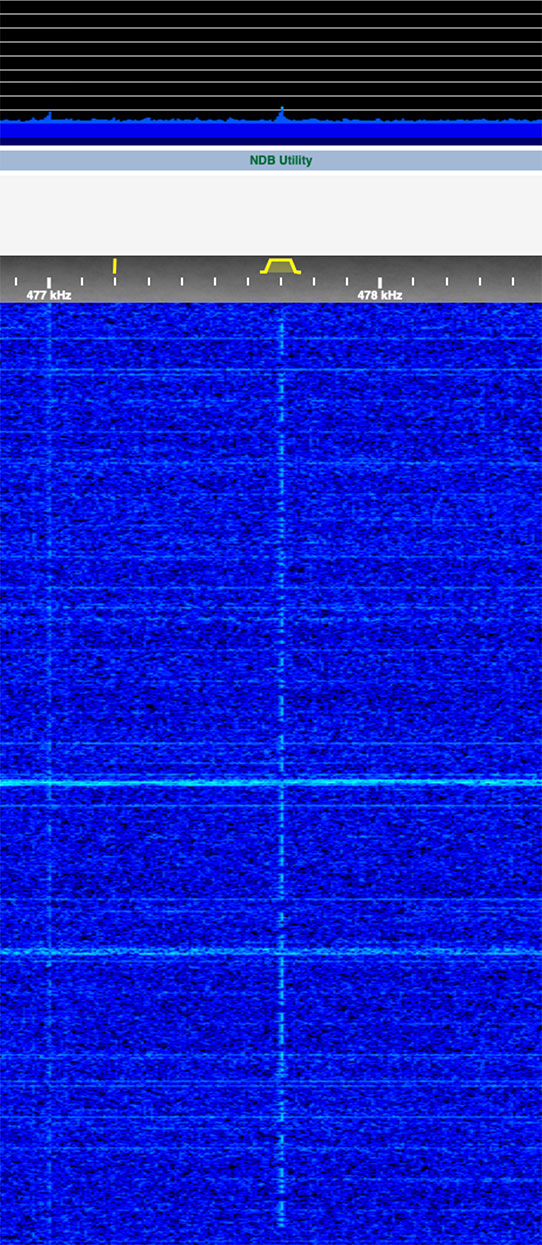
Good reception at EI0CF around 0100 utc.
30 May Graham's report:
vo1dza Audio
May: Played with neom8, lm7410 and nano. QRV agn.
3 May: Problem with the Arduino Uno (#1)/AD9850. This outfit worked well for a decade,
providing at VLF LF and MF carriers 8.27 8.277 136.5 137.477 137.777 477.7 478.477 and
1999 kHz. The synth was clocked with an Oscilloquartz 8663 10MHz DOCXO calibrated
against WWV using harmonic regression to estimate diurnal frequency deviations of the
the received signal.
14 Apr 2022: Reception reports over past fortnight:
F5WK SM2DJK DL0AO(by DF6NM) G0HIU G7SWL G4SDG PA0LSB LA3EQ LA3EQ/MW PA0OCD KD2OM G0FYD G0NBD PA0RDT G0KTN F6CWN G8FZKSDR(VY2HF SDR)
02-06 Apr. G4SDG PA0LSB LA3EQ LA3EQ/MW PA0OCD KD2OM G0FYD G0NBD PA0RDT G0KTN F6CWN G8FZKSDR
DF6NM (DL0AO) decodes and lively discourse on RSGB reflector.
02 Apr.
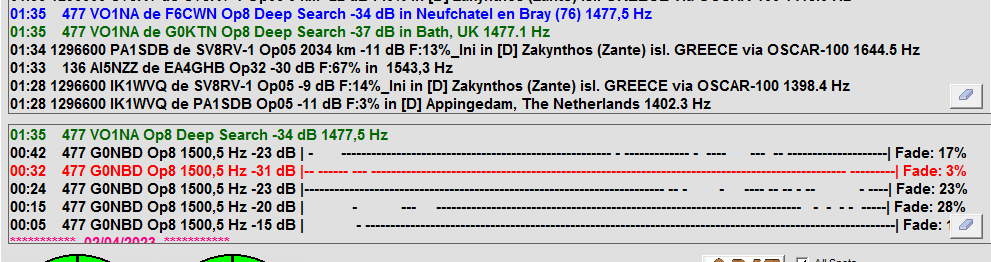
TNX F6CWM
01 Apr. No spots yesterdy, but today, Graham reported some and
from http://spots.microwavers.es/index.php:
PA0RDT JO11TM ;
G0KTN IO81TI;
F6CWN JN09TT ;
G8FZKSDR FN86LF
31 Mar. 478.477 kHz 50 watts Opera mode to 100m rotated L at h_bar=20m.
27 March. Mark reports a morning reception -- but a bit weak.
23,24 Mar. VO1DZA: improved reception.
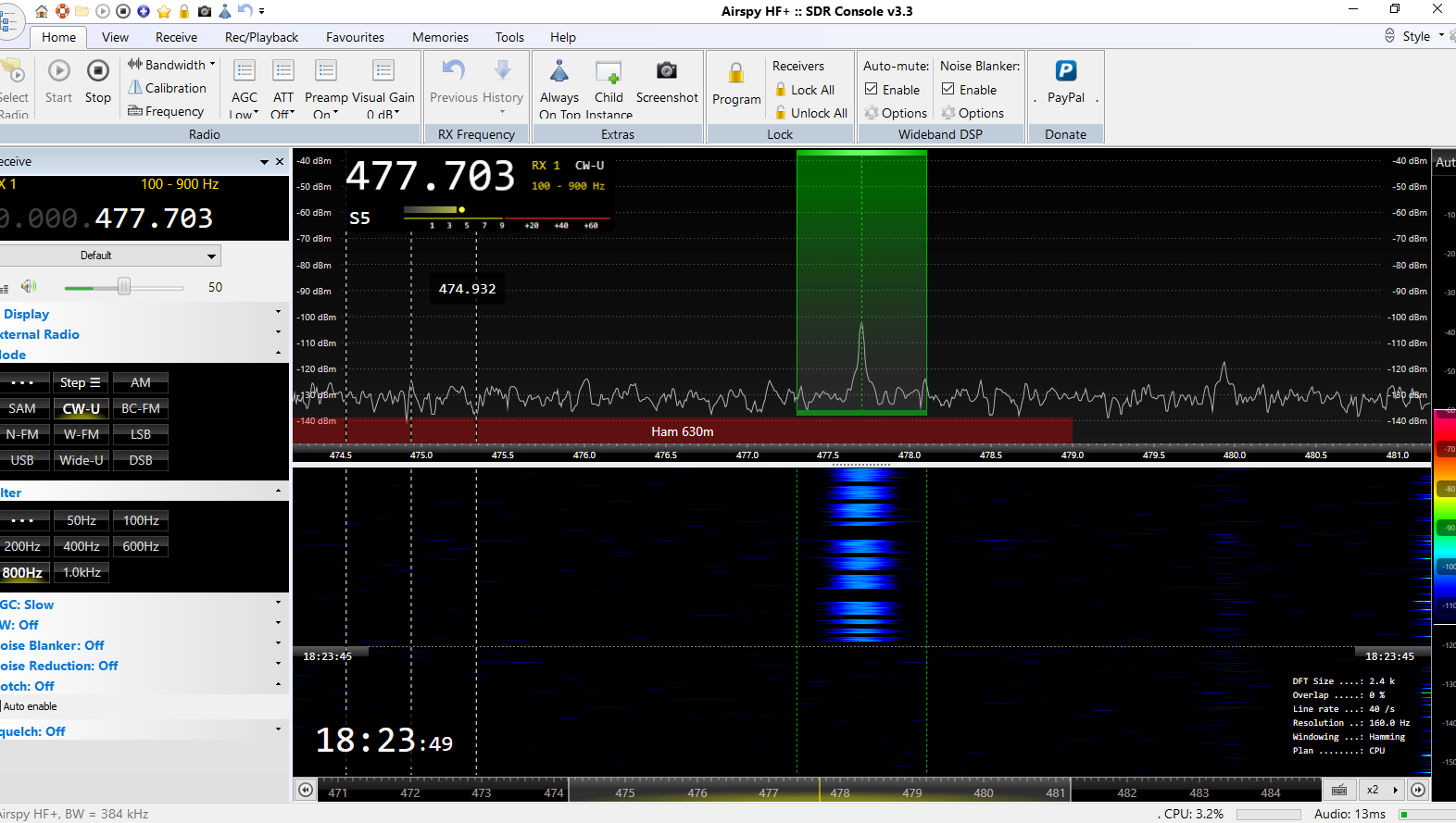
22 Mar. Aerial spliced and raised. QRV 35 Watts CW beacon 477.7 kHz 1930 utc.
4 Mar. First reception at VY2HF SDR since 27 Feb.
3 Mar. Stronger sigs at VO1DZA following synthesiser reboot.
SWR nominal.
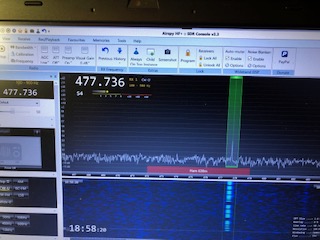
27 Sharp dip to -138 in Kyoto dst after hovering around 0.
Auroral zone has moved to low lattitudes. No trace of sigs in PEI, TF, EI.
26 Feb. SWR up. VO1DZA : weaker 10 dB below s0.
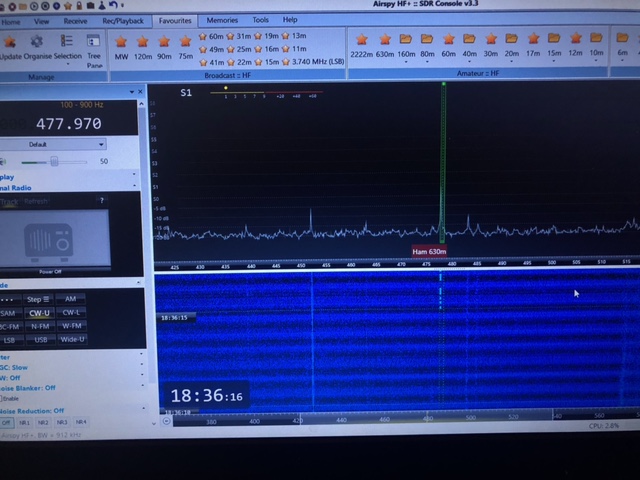
11 Feb. Aerial downed by ice; respliced and raised ~1400 ut.
10 Feb. 20 dB above noise at VO1DZA.
6 February 2023 1905-1915 UTC = 1535 - 1545 Newfoundland time; Frequency : 477.7 kHz
Receiver : Kiwi webSDR at Clashmore in NW Scotland (IO78HF)
Antenna : 920 metre Beverage aerial beaming 305° (towards North America)
Signal Quality : weak but clear and stable Thanks to Mark G4KGA for this report.
Audio
29 Jan. Report from Jorge EA1FOV.
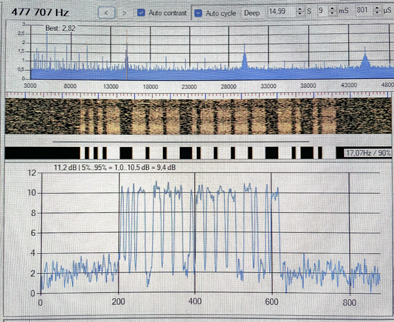
Jorge was using an AirSpy HF+ SDR receiver and a PA0RDT MiniWhip.
TX 80 watts to a Rotated L 20m high
and 100 metres long. ERP about 5 watts. The carrier is
derived from a 10 MHz DOCXO clocking an AD9850 sythesiser and keyed
using a raspberry pi. The TX is a class E IRFP260 with a B+ of 40 V.
28 G8KDL early reception at 1830 ut. Local sunset 4:55 pm.
Audio from Tracey G5VU on the Barry Davies Memorial Receiver (BDMR)
located in Clashmore, Sutherland, Scotland, Grid IO78HF.
27 Jan. Exceptional reception yesterday by Steve G8KDL by email this morning. Also
received at SDR's at TF4AH, VY2HF and EI0CF. TX on at 2019ut.
G8KDL
16 Jan. Aerial iced down. Was transmitting 50 watts 1o WPM beacon
on 477.7 kHz for past couple of days. Aerial raised 2020ut and
beaconing resumed. 50 watts, 477.7 kHz 10 WPM.
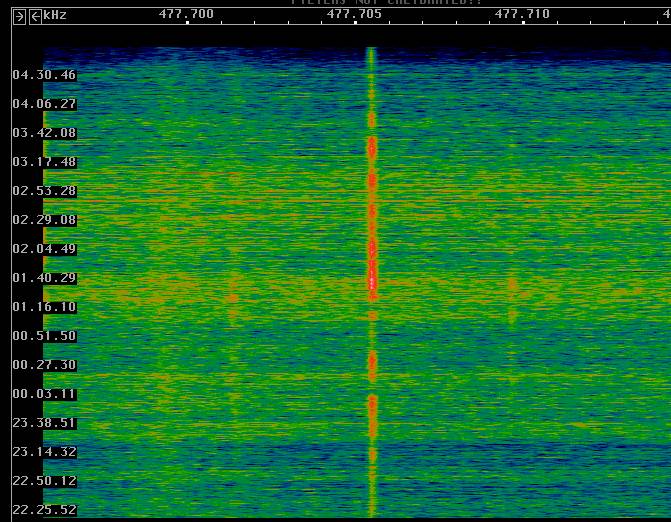
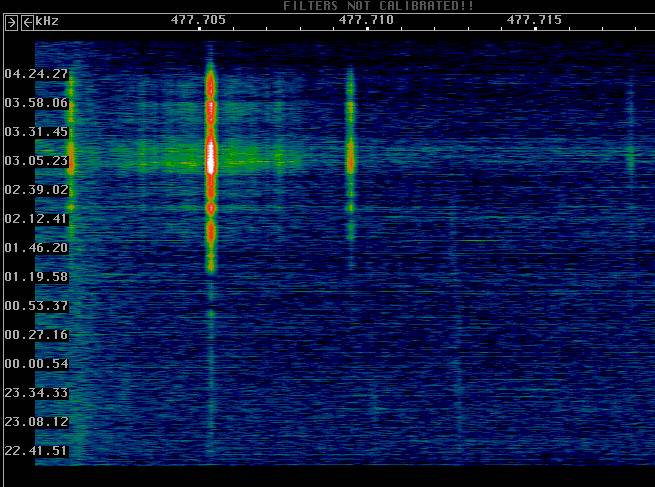
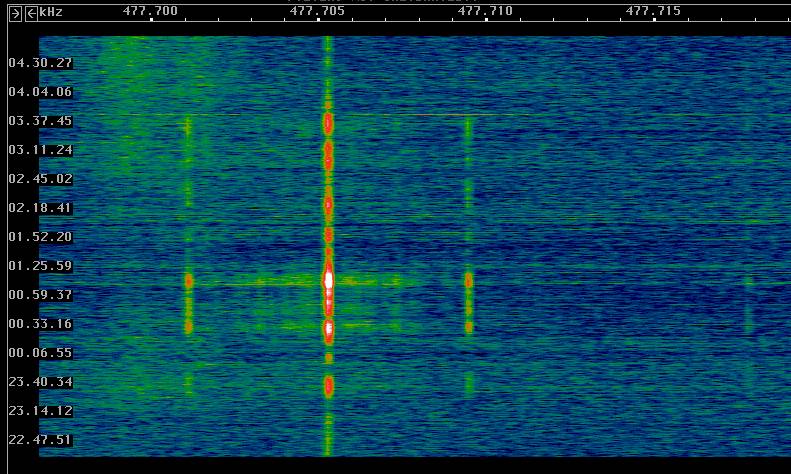
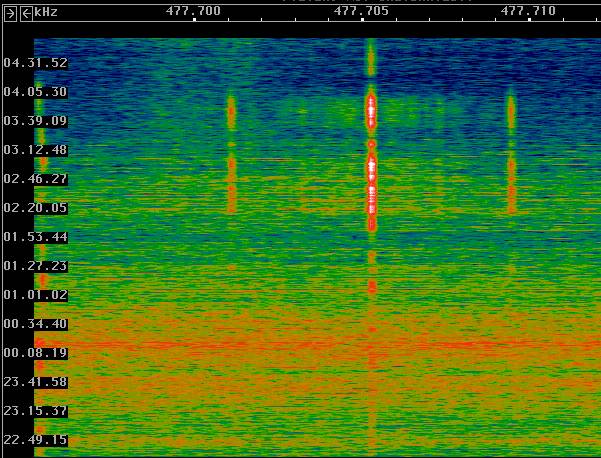
February: 40 watts to the monopole. 12 WPM CW 477.7 kHz.
2nd: Email from G0MRF who 'awoke at 5 am for reasons unknown'
and had a listen after seeing the spectrogram. A lovely
copy was attached.
14th: VO1UL 557 report at 9:30 pm but not hearing it during the daytime.
15th W1TAG: QSB but clear on peaks in central MA. (Icom r75 and ext. 300 Hz
af filter). Sal, K1RGO QSB and vy weak copy at 0218 0253.
21-22nd. Good copy of QRSS10 by Nicolas F4DTL and Roelof PA0RDT early in night.
24th. Partial reception around 0200 by Sal K1RGO.
January. Several runs of OP8 on 478.477 and CW on 477.7. 31st: Email from Joe VO1BQ: '599 on my Mag Loop, 559 on my HF9v vert.' VO1VCE: Heard it several times (in Goulds). 3rd: VO1UL (QRA 500km) "very clear: gud sig" but conditions poor 80 metres for local work. PA0RDT: good but variable on 8th, poorer on 9th.
November. Opera transmissions on 18-19 copied by ka9cfd, ku4xr,g0luj and
pa0rdt. 40 watts to the big RL (100m x 20m mean height)
19-21: (Unique) reports from http://spots.microwavers.es/index.php
LA3EQ G3XBM G0NBD G6AVK F5WK PA3ABK F4DTL/2 SWL/K9 EA5DOM-1 KU4XR PA0RDT
KA9CFD G0LUJ 21 Nov TX off 1000 utc.
October: 2 Oct. Roelof gets near aural reception as conditions improve
following dst drop. 3rd. QRSS10. PA0RDT reports 3rd, good 4th better
with dawn enhancement. F4DTL also sends a trace of the QRSS10
as recived on an icom and mw. 6: K3SIW gets trace on QRSS3 in deep fades.
7: F6CNI F5WK F4DTL PA0RDT report strong sigs. 8: F4DTL and PA0RDT:
strong sigs. Roelof also hears JT (Stephenville) and LT (alert)
9,10th strong sigs reported by PA0RDT. Switch back to 12 WPM CW.
VO1UL reports very clear sigs in St Anthony and relays them back
by landline.
Stefan's copy on the 10th
11th.Power now 12 watts.
27 Oct. 00ut several CQ calls but nil. 12 WPM CW beacon every min/2.
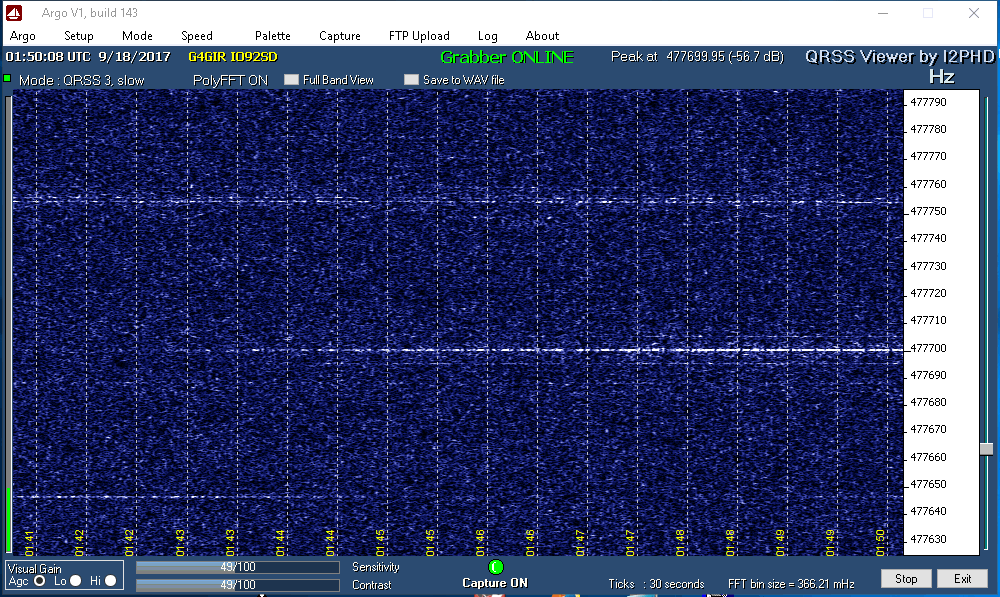
15 September Beacon on for American listeners for whom this and 2200m will be available in a month. 40 watts to the re-erected big RL. Report received from PA0RDT of aural reception and strong sigs on the linrad spectrogram following poor condx. 17-18th Report and ARGO plot from Ian G4GIR showing clear traces at 0200 with the correct 15 second periods but no dits and dahs could be resolved in the QRSS3 window. Ian's Spectrogram Roelof says conditions were poorer tonight. 20th increased power to 80 watts. Report from Roelof 21st weak, 22 aural in morning. 23rd. Roelof has audible reception in linrad 10Hz bandwidth. 24-25 Aural copy at PA0RDT in improving conditions. 26 John W1TAG reports 569 from Maine. 27: Conditions continue to improve. Ian G4GIR gets his best argo copy (clear elements) and Roelof posts a strong linrad copy, but notes a drop in the dst.
August. Continuing with 14 watts 10 WPM CW to the monopole. received at various locations in Bonavista Bay with portable RX/miniwhip.
20 July. 25 watts from the MKII QRSS10 to monopole. 27th Roelof gets a good copy of the QRSS10 after monitoring for several days. Now 10 WPM CW at 14 watts using the original TX with 18V B+. Nice aural copy by John w1tag 0045 28 Jul.
7 April: The 630TX Mk II is commissioned. QRV with 25+ watts output (17V 2A DC)
QRSS10 to the monopole. Readable sigs at PA0RDT
 at 0230. Roelof could detect sigs
from 0000-0530. There was a fade 0320 until another peak at 0420.
10th. Aural copy ~2345 by PA0RDT. Report and captures from DF2JP.
12th. Another aural in 20 Hz by PA0RDT. Opera8 for the 13-14th.
14 apr 2017
at 0230. Roelof could detect sigs
from 0000-0530. There was a fade 0320 until another peak at 0420.
10th. Aural copy ~2345 by PA0RDT. Report and captures from DF2JP.
12th. Another aural in 20 Hz by PA0RDT. Opera8 for the 13-14th.
14 apr 2017
F6CNI 4062 km 04:31:23
PA3ABK 4056 km 04:30:17
PA7EY 4044 km 04:30:18
PA0RDT 3994 km 05:15:18
G6AVK 3792 km 05:15:20
G0LUJ 3500 km 05:00:20
KU4XR 2882 km 08:15:32
KA1LM 1620 km 08:30:19
15 apr 2017
KA1LM 1620 km 05:45:02
PA0RDT 3994 km 05:00:02
F5WK 4026 km 05:00:01
G6AVK 3792 km 04:45:03
PA7EY 4044 km 04:45:01
F6CNI 4062 km 04:31:07
PA1SDB 4150 km 04:14:46
LA3EQ 3973 km 03:30:01
16,17 QRV again.
20 Apr. Report from PA0RDT, poor condx, weak peak around 0300.
Not audible. 22 Apr. Monopole is iced and the new TX draws lots
of current when keyed, violently pegging the 5A ammeter.
Traces of dot 10 from DF2JP seen on 476.165 kHz.
31 March - 2 April. QRSS10 10-20 watts monopole. Reports from PA0RDT, DL2JP and VA3VVV.
05 Feb 2017 dxsummit spot from ve2pep 477.7 kHz 0500 ut 529.
4 Feb. VE7SL 2nd ANNUAL WINTER 630m ACTIVITY NIGHT TX 477.7 kHz, QSX 3525.5 kHz.
Open for crossband QSO's 2130 (4 Feb.)-0130 (5 Feb.) UTC. Beacon 0130-1000 UTC.
02 Feb:
Roelof's spectrum at 0400
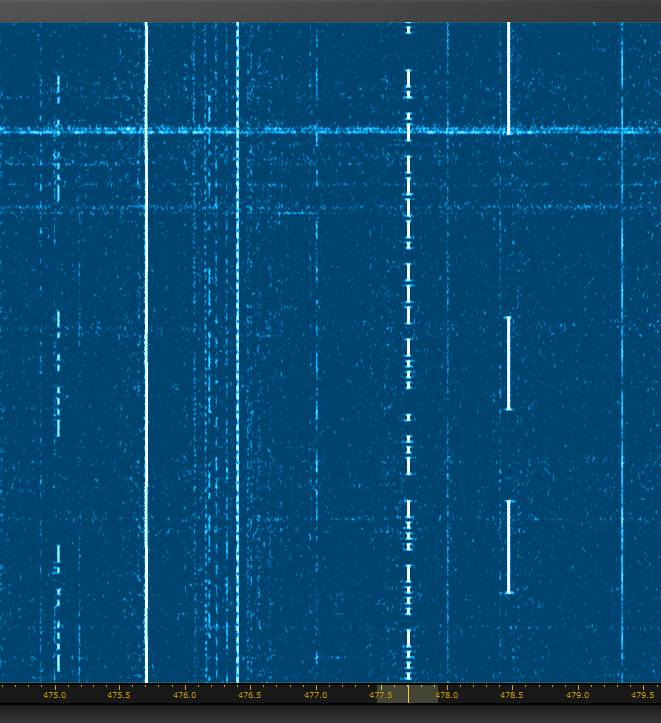
and the corresponding audio clip
Conditions were very good at times but variable as seen from his
linrad plot.
22 Jan. 50 watts dot 10 ad9850/tc4426/irfp250 class e/big rl.
25th. QRSS10 seen at EA5DOM, DK7FC tree with some traces and qrm at DF2JP.
QRT for ice storm. Tried feeding a bit of RF to the lowered aerial.
PA0RDT picked up the 10 watt sig and again on the 27th and 28th with
50 watts to the raised wire. 28,30th 10 WPM with reports of good sigs
from Roelof. 30th. 10 WPM again. 50 watts to the big RL.
12/13 November 2016. ANNUAL FALL 630m ACTIVITY NIGHT: coordinated
by Steve VE7SL. Scheduled operation: QRV 12 Nov 2130-13 Nov 0130utc.
TX 477.7 QSX 3562. Several other Canadian stations will be on.
A loose connection in the B+ meant a delay of 5 mins until QRV on the air.
QRV 2135 (6:05 NST) running 50 watts to the big RL. 6 QSOs including
one 2xCW on 630m with PE5T. Remainder were crossband, listening on 80.
The PE5T Q was the is first TA from this station since the 630 was
authorised to all Canadian amateurs in 2014. Frank VO1HP worked PE5T
by listening on 475.2 and transmitting on 3562. In the log:
VO1AKA N1BUG PE5T VO1DI VO1HP and W3LPL with reports ranging from 519 to
599. Also heard the YWA ndb on 517, wg2xka on 472 and wg2xiq on 474.
Reports: DL3ZID (best QRSS3 at 0240 on Spectrumlab) OZ6AQ (529)
F6CNI(barely perceptible). No cpi in noise at k1rgo.
26th QRSS QSO PARTY: Nothing received here on QRSS3, but QRSS3 transmissions
every 10 minutes (50 watts to the big RL) were reported by
F6CNI DF2JP and DF6NM. A hardware clean-up is underway in the shack.
Oct. 21-22 CW beacon. 20 watts to big RL. 569 in Whitbourne, 559 in
Dunville. 23-24th 40 watts CW.
Clear reception of QRSS3 and carrier using remote reception at
DF2JP site. Signals were almost audible. PA0RDT spectrogram
shows good reception 2200-0100 with Roelof reporting audible sigs.
25th. QRSS3 clear on DF2JP streamer and aural reception again at PA0RDT. 26-27 A=48 K=5. Nil at DF2JP: Joe
sends a magnetogram showing a strong dip in the field. Poor reception
at PA0RDT although better than a NDB in NS when the QRN subsided in the
morning. Local reports VO1DI solid, VO1LM (27th, 429) VO1UL and VO1VCE nil.
27-28. Roelof notes a slight improvement in sigs but QRN is preventing
aural reception. 519 at VO1AKA. 28-29. Conditions remain depressed. QRT for a while.
01 June PA0RDT reports stronger sigs from VO than I. TX on again 2208 utc
20 watts to the big RL.
18 June. Excellent copies at pa0rdt (0020-0330) and on the garden grabber
of DK7FC, though 2 Hz high. ( 30 watts to the big rl, QRSS10)
19 Jun. 20 watts to the big RL. Good copy by PA0RDT, DF2JP and DK7FC,
19 Jun PM. 5 WPM Beacon copied 339 by Dave VO1LM. No copy at PA0RDT
20 Jun. VO1DV reports S6 signal strong and readable. DF2JP (red pitaya,hdsdr) and PA0RDT
(perseus, linrad, and miniwhip) copy the sigs. 22: DF2JP gets traces. PA0RDT gets an audible copy in
5 kHz bw. 22-23 Jun 5 WPM and 10s carrier for comparison of aerials.
24 June Registered at "www.472kHz.org".
28 May. 20 watts to the big RL. QRSS10 477.7 kHz. DK7FC : sigs too weak
for detection. PA0RDT: strong reception in heavy QRN but not audible.
29 th. PA0RDT and DK7FC report weaker sigs.
01 March: EbNaut 30 Watts 477.7 kHz 8K19A 10 Chars, 752 1-s symbols.
02 DF6NM copies 6 frames. A new record for 630m EbNaut! Congrats Paul and Markus.
Wed. 2016-03-02
start car. sym. offs.
UT dB dB mHz
00:00 2.5 1.6 -3
00:30 2.2 0.8 0
01:00 2.1 0.8 -2
01:30 0.8 0.0 -1
02:00 nil 0
02:30 nil 0
03:00 3.3 2.5 -1
03:30 3.4 3.0 -1
04:00 nil +1
04:30 nil 0
02-03 2 S symbols. df6NM's reception;
start car. sym. offs.
UT dB dB mHz
23:30 11.9 7.9 0
00:00 12.9 10.0 -1.5
00:30 16.1 13.6 -1.5
01:00 11.6 8.3 -1
01:30 16.9 14.2 -0.6
02:00 10.7 8.3 -0.6
02:30 17.9 14.4 -0.6
03:00 14.1 10.8 -0.6
03:30 5.7 4.4 -0.8
04:00 5.2 5.1 -0.8
04:30 3.6 4.0 -0.8
Also PA0RDT reported strong sigs. Audible.
3-4 March. Very strong sigs at PA0RDT and DF6NM reported a decode of
the message "G. MARCONI" as a result of his analysis of signals
received at IZ7SLZ.
4-5 March. PA0RDT gets another fine copy.
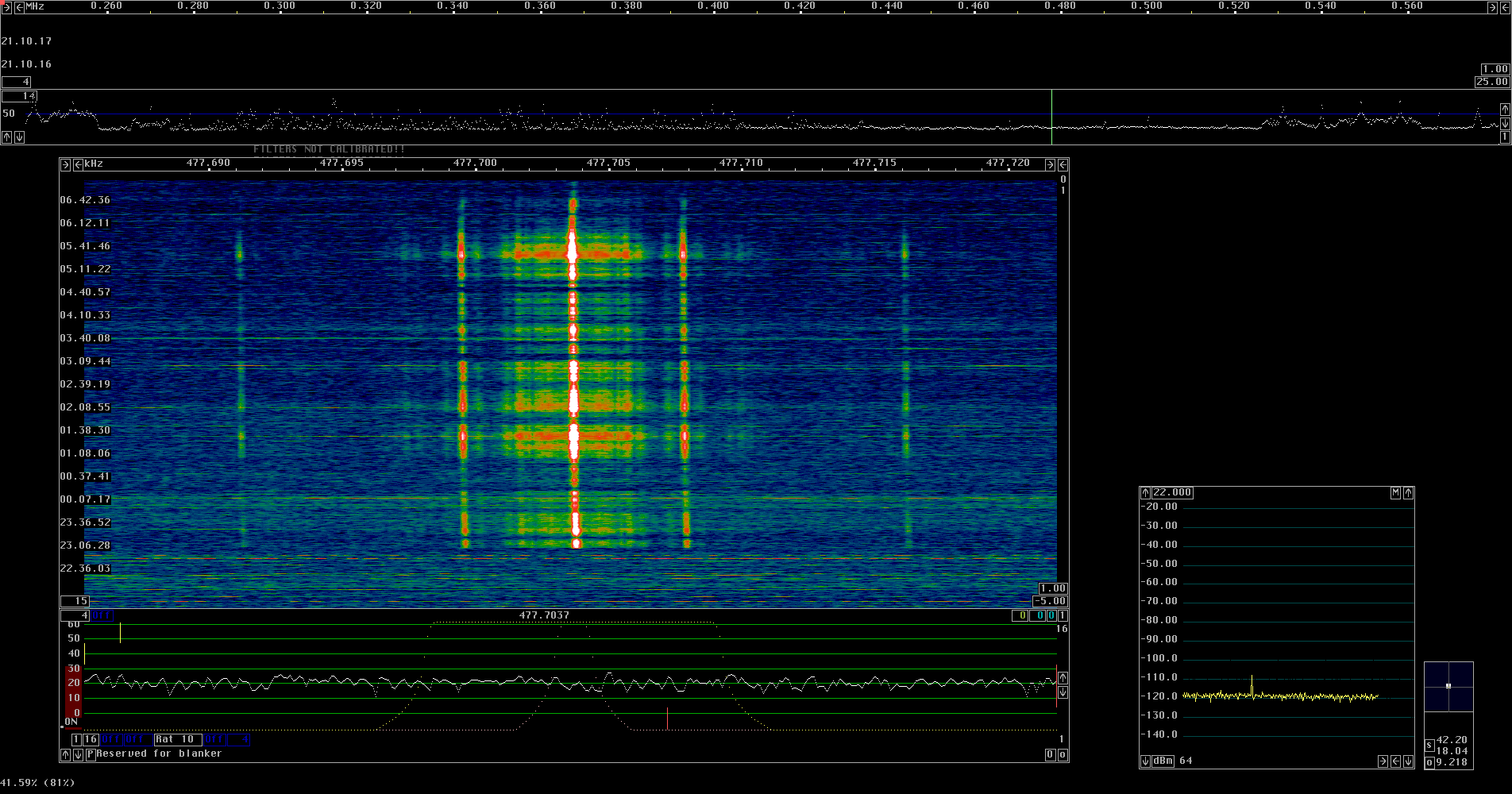
And a very clear aural reception
And if the first one doesn't get through, try them all at once.
Markus does a remarkable superimposition.

He writes:
" ...carrier trace was quite narrow so conditions were stable again last
night. Weak sidelines at +- 4.16 Hz corresponding to the dot rate were
also visible.
Unlike Roelof, I have no chance of actually hearing your CW message here.
So I made an attempt to bring it out of the noise using coherent averaging.
The saved data files from 23 to 6 UT were assembled into one large array. Then the phase evolution of the AM carrier was estimated and used for
synchronous demodulation (just like in opds). Thus the modulation appears in
the in-phase baseband component, allowing coherent averaging of multiple
message repeats.
From the sidelines I knew the dot duration, but I had to use trial and error
to find the message length. In the end, a cycle of 208 dotlengths (25.0
0228 s) and 1126 averages turned up an easily readable fast-CW decode, show
n in the attached screenshot (black =3D in-phase, cyan =3D quadrature). "
6-7th. Poor reception at DF2JP of the 10 WPM CW. The DST had taken a 100 point
dip. 7-8 CW 10 WPM 40 watts to the 100m RL at 18m. VO1UL reports weak sigs.
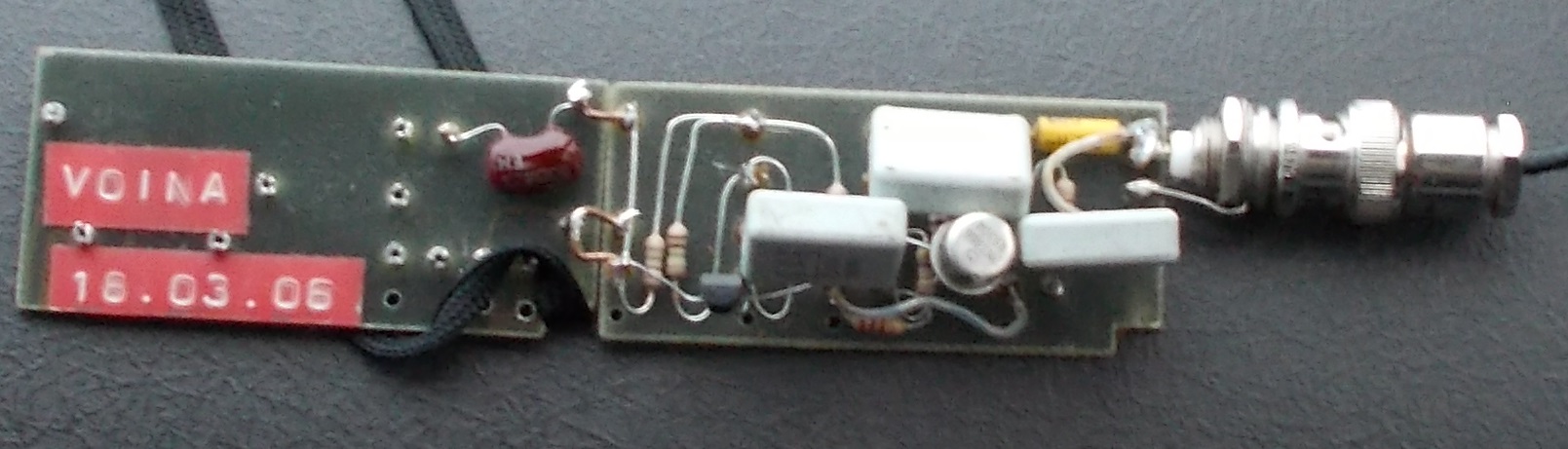
The minmiwhip (VLF-HF E field antenna) celebrates its 10th birthday.
It was designed by Roelof who used his miniwhip in a hawthorn tree to
show how reception of CW signals on 477.7 kHz varied over the past week.
TNX to VE3OT for some bits used to assemble the MW.
--
27,28 mar. 30 watts to the rl. 27th fair copy by PA0RDT. 29th better copy.
30th. A strong peak in the morning 0430-0530 near sunrise seen at PA0RDT
who reported audible signals.
30. Not quite as good but audible, reports PA0RDT. 31st. 10 WPM and QRSS3.
6,7 Feb 2016. First Annual Mid-Winter 630m Activity Event (TNX to Steve VE7SL) QRV CW 477.7 kHz
QSX 3.562 kHz 2130-0130, QRSS3/12 WPM beacon 0130-1000 UTC. QSOs: N1CGP VO1BQ
VO1FOG and a dozen reports from VO stations. VE7SL received a report
from K7CW of audible reception on the west coast at 0219UTC.
14-16Feb EbNaut 477.700 8K19A 1 S chars 20 watts to monopole. RL is
on gnd thanks to Mother Nature. No characters copied by DF6NM nor
IZ7SLZ. Markus says phase stability is not good for EbNaut MF.
at least for the 1 s symbols. A couple of strong copies at PA0RDT but
generally very weak.
17th-20th QRSS30 20th 2100 utc RL up again. 30 watts EbNaut 8K19A
Not the slightest trace at DF6NM.
21-22nd. Good at times at PA0RDT but nil at DF6NM.
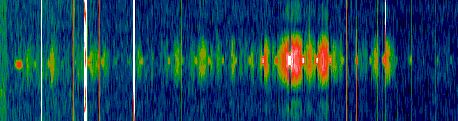
PA0RDT using a miniwhip in
a hawthorn tree to capture sigs on 22 Feb.
24-25th. 10 WPM CW copied by Roelof. Good reception over the night.
25th. Good copy by Roelof and detection by Markus DF6NM. 26th Early detection
by DF6NM but weaker than last night at PA0RDT.
--
January 2016
Sked request from G0MRF and good excuse to check out
the 630m stuff. First the tower wouldn't accept RF. Evidently the
100m rotated L (15m average H) was mucking up its impedance.
Tried the RL with a few dozen 3" turns of 2 mm insulated wire.
Min SWR (under 1.5:1) and 0.75 amps at 20 watts. Set back power supply
variac to give 10 watts. 12 WPM sigs were received in Markland QRB 68 km.
Crank up the variac for QSO attempt with G0MRF/p 50 watts to a 100m rotated L
at 15m average height. No QSO but traces
of signals received both ways. WA3ETD reported reception on this side
of the pond at 0154.
NL reception of Joe's callsign transmitted by Dave
And overseas,
Dave receives his callsign transmitted from here
3rd. QRSS3 beacon 50 watts.
4th QRSS beacon 30 watts for fear of fried fet!
Clear spectrograms received from PA0RDT and DF2JP. Thanks !
14-16 Jan 2016. 30 watts to monopole. Reports and spectrograms qrss from F1AFJ F4DTL and PA0RDT. 16-17th CW 30 10 WPM 30 watts to the unloaded monopole. Capture by F1AFJ. 28-30 Jan. QRSS3 sigs clearly received at W1VD PA0RDT. 30-31 Jan. Captures from PA0RDT and F1AFJ. Ebnaut request from IZ7SLZ. 31Jan-01 Feb. Ebnaut 75 chars K19A 1936 symbols 387.2 seconds 10 watts continuous carrier. The GPIO pin for QRSS is also used for a pi phase shift! Shoddy! 1-2 Feb 2015. DF6NM and IZ7SLZ tried to get the ebnaut, but no luck. Tonight ran 20 watts with 8K19A and 1 s symbols. The carrier was clearly received at F1AFJ with much QSB and audible at times at P0RDT.
1st Annual Midwinter 630metre activity night. Crossband 80/630m QSO's: N1CGP VO1FOG and VO1BQ. Reports: DF6NM PA0RDT(aural) VO1UL(vy weak) VO1SR(s6-8) VO1IRA, VO1DV(s6) VO1FJS (10dB/s9) VO1FOG(10dB/noise) VO1JA(nil) VO1KBN(nil) VO1UL(better in evening than this morning [5 Feb]) VO1VCE(copy) VO2ET(clear copy) VO1YR(Q5 at S3) VO1HX (nil) VO1EGH (599) 7th, 1301 UT. Cod Jiggers Net: VO1KVT(nil) VO1FJS(599+10) VO1BQ(599) (VO2ET nil [qrm from carrier]) QSO with VO1BQ and TX off at 1355 UT 7 Feb 2016. Many thanks to Steve VE7SL for organising this event. PA0RDT audio clip from ~0200 7 Feb.
 ON7YD aural at 529
  F4DTL
F4DTL 09 Nov. OP8 40 watts on 478.477 kHz using the
new divider/keyer/driver
(7493/7400/4427). 40 watts. Reports from G0NBD and G3XDV.
F1AFJ 3949 km 05:56:11
PA3ABK 4045 km 05:24:37
2E0ILY 3533 km 05:03:35
LA3EQ 3958 km 04:00:30
DF2JP 4188 km 04:00:30
DL-SWL 4400 km 02:57:24
F4DTL 4005 km 02:57:23
G3XDV 3720 km 02:15:20
W3NF 2149 km 01:54:17
G0NBD 3495 km 01:33:15
10-11 Nov.
F5WK 4017 km 02:59:23
PA3ABK 4045 km 02:59:23
G3XDV 3720 km 02:59:23
2E0ILY 3533 km 02:38:21
F6CNI 4052 km 02:06:48
G8HUH 3550 km 01:45:46
12 Nov
DF2JP JO31HH
F6CNI JN19QB
G0NBD
G3XDV IO91VT
G4WGT IO83QO
G6AVK JO01HO
PA3ABK JO21IT
W1TAG FN42CH
W3NF FM19MH
October 2014. 24-27th. 50 watts cw beacon to monopole. Copied over 250km land path: weak CW heard in Grand Falls using a 2' loop. 30th. 70 watts CW beacon overnight. 31st. CW beacon on 477.7 QSX 3562, 7062 kHz for crossband contacts 2130-0130 UTC. Reports: CW VO1BQ 579 EI7BA 439; VO1UL PE5T DL4HYF F6CNI nil. QRSS DL4YHF RW3ADB(trace) G3XDV
Aug 2014: Low power beacon on 477.7 kHz. A special operation is scheduled
for 31 Oct-01 Nov thanks to Steve VE7SL. RX 3562,7066kHz 2130 31 Oct - 0130
1 Nov UTC. Thanks also to the 500kc group.
ARRL INFO
Low power (10W)beacon sending CW and dot10. Copied in Cavendish during night
and weakly audible at times on a 2' 16 turn loop/preamp/ft817. R=812 km.
audio 477.7 kHz.
Also heard in Eastport (r=124 km) at very consistent levels using
a miniwhip, the loop with and without a preamp (very weakly).
Reported on the reflector. 23-27 variable reports from F1AFJ of the dot10
with weak traces of the CW smear on some nights.
28 Weaker reception by F1AFJ and a few traces reported by Joe DF2JP.
29 Just traces received at F1AFJ; poor TA conditions.
7 Sept. Very weak copy in Gander, nil in Gambo. 569 on 2'loop/preamp in
Eastport. Off 2306 utc. TX moved from shed to shack.
June 2014: QRT for several days. 19th. Reports of audible sigs in strong QRN by PA0RDT, but good copy on QRSS10, also by F1AFJ. The beacon was running CW and dot 10 since the 15th. 50 watts to the monopole. 20th. A weak but certain capture by F1AFJ 00:05 > 00:27 utc. 21st. The solstice: weak sigs reported by F6CNI 0220-0235 but nil at F1AFJ.
01 May 2014: 630m officially becomes a new Canadian band. See the latest
IC Table of Frequency Allocations
4th 0045 UTC a ceremonial CW message was sent on 477.7 kHz.
5-6 Continuation of message. 7th. QRSS10 starting 0100.
8-12 12WPM and QRSS10 beacon 50 watts. 477.700 kHz 13th: weak QRSS copied
by F1AFJ but nil at F6CNI. 14th. QRSS quite readable at F1AFJ and F6CNI.
16. Weaker copy by F1AFJ; 2150 UTC VO1UL copies CW at 339.
High QRN and K=2. 17th nil at AFJ and CNI, but weak sigs at F6HCC.
 F1AFJ on the 13th.
 F6CNI on the 14th.
 F6HCC on the 17th.
18th: Better reception by F6HCC.
 G3XDV on the 19th. QRN at AFJ
21: Good copy at AFJ.
22 Good reception of QRSS by F1AFJ but nil by F6CNI the past 3 days due to QRN.
23: F1AFJ: good between 0048 and 0107 then QRN. F6CNI 0036-0144 and 0243-0306
grey line but weak.
24th: F1AFJ writes "NA visible cette nuit de 00:15 > 01:30 , 03:05 > 03:50"
26th. 0330-0400 only at AFJ.
27. Nil at F6CNI and F1AFJ.
28: F1AFJ a dit: Juste de 00:35 > 01:00 plus une trace vers 04:50
et A6CNI a dit: réception était faible mais constant de 0030 à
0240 TU. 30: variable reception by F6CNI but nil on the 31st.
April 2014
1st. Good QRSS sigs reported by PA3CPM and PA3FNY. CW beacon on 477.7 kHz
50 watts to the monopole. ERP 1 watt.
3rd CW beacon 12 WPM.
14th QRSS beacon 2230-1000 utc.
15th qrss10 beacon 1955-1018. Copies by F1AFJ and F6HCC.
13 Mar. EI0CF worked again. Heard DF5QG at 339. He reported hearing VO1NA 229.
0000 15-16 Mar. Beacon on 477.7 kHz but nil heard at DL4RAJ and DF5QG.
16 March 2014. On suggestion of G0NBD, tx OP4 478.65 kHz 50 watts to the
monopole starting 2300 utc. TX off 0949. Results from pskreporter:
WE2XGR 1724 km 09:44:27
PA3ABK 4045 km 06:01:07
G4WGT 3519 km 05:30:57
F4DTL 4005 km 05:26:46
G8HUH 3550 km 04:13:45
KU4XR 2889 km 03:56:35
K3SIW-2 2848 km 02:52:11
G0NBDTWEN/SDR 4173 km 01:43:27
G0NBD 3495 km 01:30:33
W3NF 2149 km 00:30:25
And reports of 15 receptions from G4WGT and many good copies with little
fading from G0NBD and F4DTL. I
18 Mar.
G4WGT 3519 km 06:08:40
G0KTN 3587 km 05:55:54
PA3ABK 4045 km 05:55:53
K3SIW-2 2848 km 05:00:03
G0NBD 3495 km 00:46:40
G6AVK 3781 km 00:38:05
2130 CW Beacon 50 watts 477.7 kHz . Copied by VO1UL 2154 vy weak on a G5RV.
2300 QRSS/CW TX 477.7 RX 477.7, 472.5 kHz
19th. 0100 QRSS10 beacon. G0NBD plagued by noise, but "O" copy at DL4YHF in
QSB with peak at 0330 UTC and post sunrise reception. A very good copy
of the QRSS10 by F4DTL.
2130 CW beacon. Heard by VO1VCE, VO1UL 589, VO1TX 599
20th. First day of spring. 2100 cw beacon 0014 21 Mar QRSS10 until 0955.
Report from Tom SM2DJK.
22nd. DL4YHF via the LF reflector reported audible signals
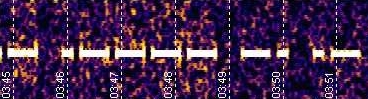
around 0345 UTC. Wolf was using an IC-706 / 60 m wire resonated at 475 kHz,
preselector/preamp off.
PA3CPM gets a nice copy on the 23rd.

.
Meanwhile PA3FNY monitors continuously. A typical peak at around 0300

Victor's grabber shows the path to be open from 2200 to 0700.
24th: TX 477.7 RX 476.12 kHz. QRSS10 starting 0000 utc. 0111 QRSS10 QSO with
Wolf DL4YHF who was running 100 watts on 476.1264 kHz to 60m inv L at 11m. Good
copy with both stations reporting audible reception at times.
Here running 50 watts. ERP 1 watt. RX FT-817 connected to TX ant.
An overnight transcript of the operation was captured by PA3CPM.
25th. CW 477.7 kHz beacon starting 2150 then listening 472.5 kHz on 0000 and
on the half hour. Reports of beacon received from VO1UL(339) VO1GO(569) VO1TX(nil). CW QSO's with EI0CF and DF5QG. CW beacon till dawn. This could be seen
as smudges on the overnight spectra of PA3NFY. Local sunrise/set 0924/2149 utc.
26th. CW beacon starting 2051. 50 watts 12 WPM 477.7 kHz.
27,28th. CW beacon.
28th 2113. QRSS10 beacon. Reports received from PA3FNY DL4YHF F1AFJ and PA3CPM.
30th QRSS10 TX,RX. Reception reports from PA3FNY
F1AFJ DL4YHF PA3CPM hinting of poor propagation. There was as solar flare yesterday. 31st. Good capture by PA3CPM and PA3FNY -- after the TR switch was set
to TX late last night.

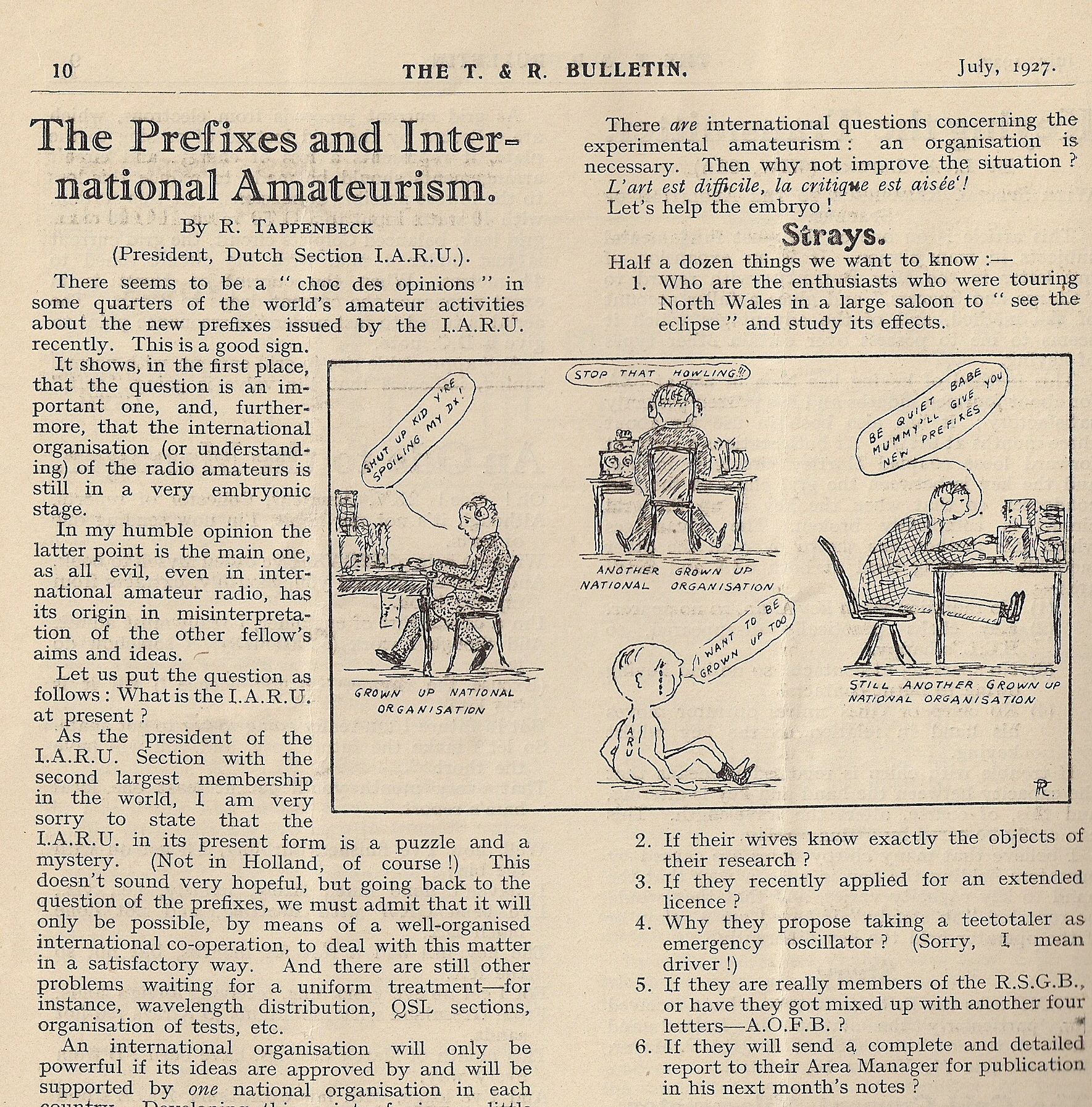
The purpose of this study is, in part, to gather information for the Canadian delegation in support of an allocation for the amateur service at the WRC2012. This was made an agenda item by the IARU. The large area of the province and the need for reliable emergency communications makes this study of considerable regional importance. The IARU has a long history (From "The T. & R. Bulletin" 3,1, July 1927) Copyright of the Radio Society of Great Britain and reproduced here with their kind permission.
Publications appearing in "The Canadian Amateur" Thanks to Radio Amateurs of Canada.
TCA May/Jun 2008 p.6
TCA Jul/Aug 2009 p 10.
TCA Jul/Aug 2010.
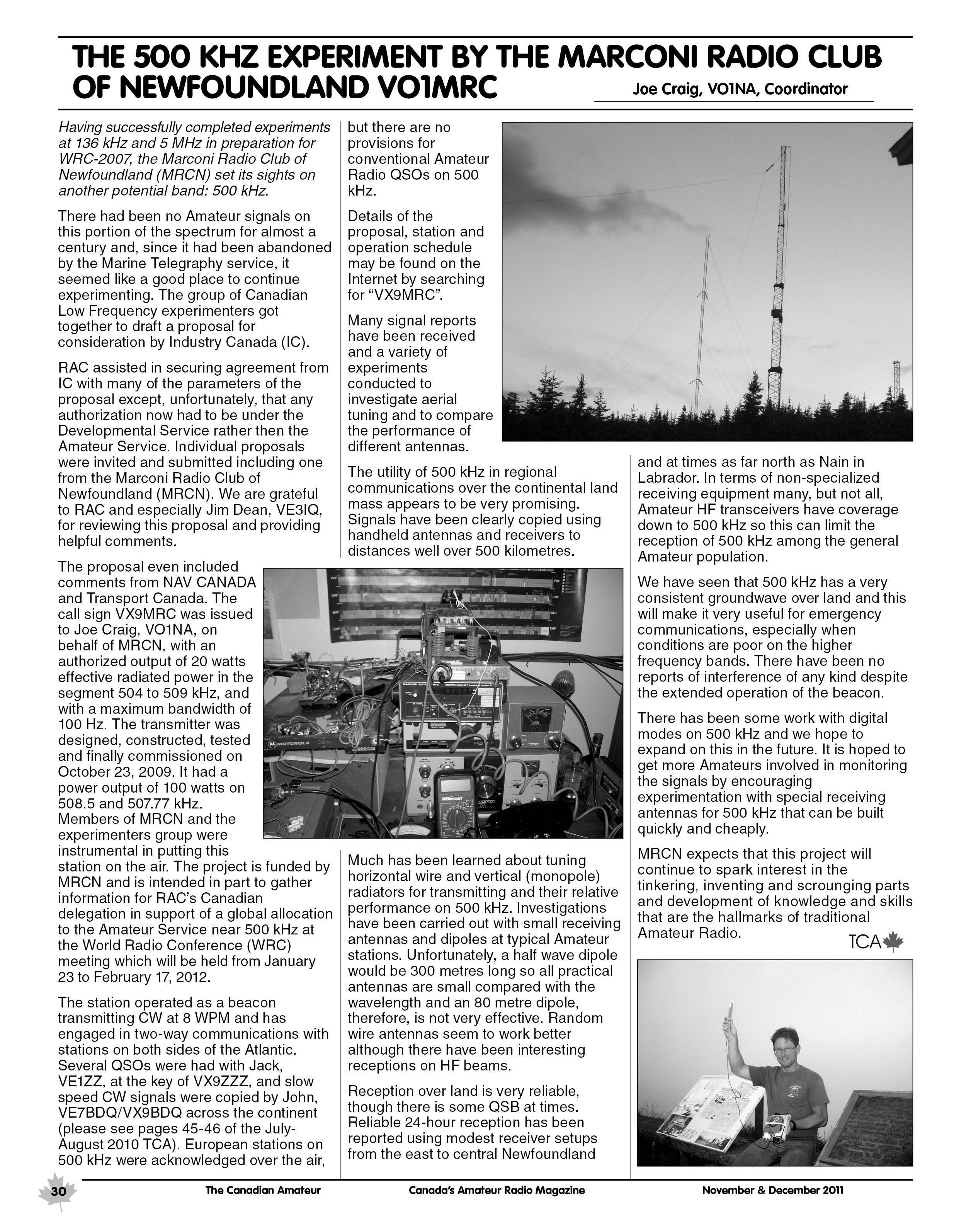
TCA Nov/Dec 2011
EI0CF
VX9ZZZ
GM3BST
VX9MRC
VX9OHH
VX9BDQ
G3LDO
G6CI
Operation Schedule / Signal Reports 2013
Reports received: EI0CF; VO1BQ; VE2PEP; VO1SQ 599; VO1UL 559; VO1ER R1;
VO1DV 579; WE2XGR/2 579; 15th VE1VDM; VO1FJS 599+20; VO1UL; VO1CAL 589;
VO1VCE; VO1FB 599+ (VX9MRC 477.7 kHz 14-15 Dec)

VE1VDM capture.
VX9MRC working frequency is 477.70 kHz, 1.5 watts ERP.
14th
0000 QRSS3; QSX 467.17 kHz
0100 CW RX 477.7, 472.5
200-2259 CW telegram transmission
300 CW RX 472.2, 477.7 and 3700 kHz
15th
000 QRSS3; QSX 467.17
100 CW RX 477.7, 472.5
200-2259 CW telegram
300 CW RX 472.5, 477.7 and 3700 kHz
EI0CF 477.7 kHz 0052 09 Dec 2013
2 December 2013. An announcement is made on the Evening NL Net on 3740 kHz concerning the operation on 14-15 December. VO1VZ, VO1YR, and VO1UL have expressed interest in participating. It is hoped to get as many amateurs as possible to copy the message and send it to their municipal representatives. This operation is to focus attention on the proposed new band and the value of amateur radio in emergency communications. It is dedicated to the memories of Dr Ken Pulfer, VE3PU who worked at the WRC2012 to secure the new band, to Wayne Smith VO1TA who provided signal reports, and to Dave Colton VO1TK a member of MRCN.
The following have provided reports of 600m signals from VX9MRC: VO1BQ VO1CAL VO1ER (Gander) VO1FB VO1FJS VO1GXG VO1HP VO1JA (Garnish,r=200km 255 degrees) VO1KVT (Lewisport 235 km 317 deg)) nil VO1MP VO1NA (Demo at a breakfast meeting) VO1NC (New Chelsea) Signal strength 2. VO1JNS VO1OT (nil) VO1SJH (Port au Port, weak), VO1TA (Hearts Delight) VO1TX (St Anthony) VO1UL (St Anthony) VO1VCE (539 to 599) VO1VZ (Torbay) VO1XP (Torbay) VO1YR (Shoal Harbour) (If you provided a report and are not listed, please let me know!)
November: 630 metres in Canada. VX9MRC will be on 478 kHz 14-15 December 2013 under temporary authorisation. This operation is to focus attention on the proposed new band and its value to emergency communications for amateurs and their municipalities. A special telegram will be sent and those who copy it will be invited to forward it to their municipal representatives.
October 2013 Comments solicited by Industry Canada concerning proposed revisions to the Canadian table of frequency allocations are published.
Updates: 4 July: MRCN notified concerning IC Proposal re 472-479 kHz. 8 Jul. RAC Bulletin, 9th ARRL Bulletin. Comments are being drafted.
January: 14th 50 watts 1.2 Amps to the 100 metre wire. 504.1 kHz CW
beacon and 10 s carrier. Authorised by Industry Canada for 14 Jan-14 Feb.
17 Jan 50 watts ~0015-1045 utc. 20-23 100 watts to monopole. Copied by VE1VDM
W1VD VO1TA VO1VCE but not by VO1UL nor VE9WW.
22 Morning argo cap by G4WGT:

23. Now sending QRSS10.

29 Gary gets a few full callsigns.
February. 2nd-3rd QRSS20 on 504.1 kHz. Clear copy, audible at times at AA5AM in Texas, a new distance record for Scott. A CW beacon was set up and its operation announced over the Cod Jigger Net with reports from Dave VO1VCE in Goulds and Carl VO1UL in St Anthony on Sunday morning.
Operation Schedule / Signal Reports 2012
29 Dec 2012. DF7KC and DF6NM gradually increased in strength
from QRSS10 to audible signals on 476.172 and 476.150 kHz.


6 Nov 2012: 630m now available in Norway.
November: To commemorate the assignment of 500 kHz as a disaster frequency a century ago, VX9MRC will be QRV on 504.1 kHz on 2-4 November.
3rd: Signal reports have been received from VO1UL (449 on beam pointed north!) VO1TX (nil), VO1FB (loud and clear) EI0CF (whose call was acknowledged 4 Nov 2012) VO1OT (nil) VO1NC (S5 on 20m wire) and VO1UL on the 4th noting weaker signals than yesterday. 100 watts to the monopole, though the 100m wire was used for the transmissions on 2 November. Reports received and gratefully acknowledged from VO1UL VO1CAL who reported hearing the signals. A screen capture was received from DL4YHF showing clear traces of the signals with an SDR-IQ at DF0WD. Jim VO1YR reported strong sigs being received on an untuned 190' wire. at 1730 utc. Dick VO1ER using trap 80-10 dipole could just hear it for the first time at 2302, while Carl VO1UL heard it 559 on the G5RV this evening, stronger than the triband beam.
2 May: 5 amps to monopole. CW Beacon. Loud and clear in Kelligrews. 4-5 May. OPERA4 5 RF amps to monopole. No sigs detected at G0NBD.
April 9th: CW transmissions copied by VO1YR but not VO1UL who was getting QRM (2145 UTC). 12: Copied by VO1YR again but not VO1UL during evening. 13: VE2JWH copied beacon several times around 0430 UTC 18 May: Principality of Monaco has allocated 472-479 kHz to the amateur service with max power of 1 watt. 23 May Reception report of Argo reception by KN8AZN. 25: NO3M copied CW. 26 Weak Spectrum Lab traces at G0NBD. 27 weak but readable CW at KN1H.
15 April 2012 0001-0400 UTC. Special transmission to commemorate the centenary of Titanic disaster. 507.77 kHz CW. 20th QRSS10. 22 CW beacon copied by ear with some fading by W1TAG. 23rd 100 watts 2.5A to monopole. CW beacon.
March 3rd: Opera 4 transmissions 100 watts to the tower. Reports:
KL7UK/5 600m OPERA 3703 km (Oklahoma) 06:34:55
PA3ABK 600m OPERA 4061 kms 05:55:58
G0KTN 600m OPERA 3602 kms 05:17:00
5th: W1VD Jay copied from 0300-1000
12 Feb QRSS10
14 Feb 2012. WRC2012 Approves 472-479 kHz as a new amateur allocation.
17-20 Feb. 8 WPM CW ID and 10 second carrier. 100 watts to monopole.
23 January: 0110 UTC. 100 watts to a 100m wire. 8 WPM CW ID followed by a 10 second carrier. Opera transmissions.
Operation Schedule / Signal Reports 2011
November 2011. 6th. 30 watts 0.5 amps to a 100m wire. 5 Not heard by VO1VZ. 7: loud and clear at MUN. (miniwhip) 8 Copied by VO1VZ in Torbay. 12/13: Reception reports from Gary G4WGT(up to 559 in QSB) Rik ON7YD and John GM4SLV. Graham G8FZK who reported 'Not a beep' near Liverpool.
October 2011. 9th. 100 watts to vert. 10th: Reports received from H. Wolff, G4WGT, KN8AZN. 11th. VE3EAR reported weak traces. 13th. AA4AM in Texas DL9AAM 14th. ARGO traces by PA3CPM. 27 Oct. on at 230 UTC. 8 WPM CW ID and 10s carrier.
Jul/Aug 2011. The power is reduced from 100 to 35 watts to reduce the voltage on the tower. The beacon signal is a CW ID at 8 WPM followed by a 10 second carrier.
May 2011. Jim VO1YR has noted night time QSB of up to 30 dB. Carl VO1UL has copied the beacon at 0050 utc but not during the day. On the 11th, Jim measured the signal levels from the 21m vertical and the 100m horizontal. The latter was 7 dB down. VO1UL hears the beacon on the 21m tower but only after dark. Last night 0113 utc (12 May) and 0054 (13th) on HF beam pointing SW. 80m antenna was too noisy.
25 April 2011. Experimented with tuning a 21 metre tower on 507.77 kHz: 267 uH of inductance was required for resonance. A 100m wire was used for an antenna. The transmitter power was 100 watts. Mode: 8 WPM CW beacon followed by 10 seconds of unmodulated carrier. 2140 UTC: signal reports were received from VO1YR (Shoal Harbour) r=100 km 559, VO1TA (Hearts Delight) r=50 km 589, and VO1UL (St Anthony) r=500km who was unable to hear it until about 2320 because of strong power line interference. Carl used an HF beam instead of a G5RV because the former had a better S/N. Thank-you gentlemen. 26 Apr. Wayne reports 58/99 VO1SJH reports nil. VO1VCE: 53/59 Carl: no report. Tried loading 21 m tower, but got high SWR. Using 100m wire. 27: 0130 UTC. -57 dB (rel) at VO1YR using 80m dipole. 1820 utc. Using 21 m tower for TX. VO1JA (Harold in Garnish,r=200km 255 degrees) reports 559 sigs on 80m dipole. Ken VO1KVT (Lewisport 235 km 317 deg)) Nil. VO1NC( New Chelsea) Signal strength 2.
According to information from inquiries by Jim Dean, although standard amateur contact are not sanctioned by an international treaty, we are evidently permitted to acknowledge foreign stations who call us.
20 Feb. QRSS3 Beacon. 100 watts to 100m wire at 15m height. Weak signals seen on G4WGT grabber and reported by F4DTL. 22 Feb. PA3FNY and KU4XR report strong signals. VE3EAR,VE7BDQ,VE3GTC reported no sigs.
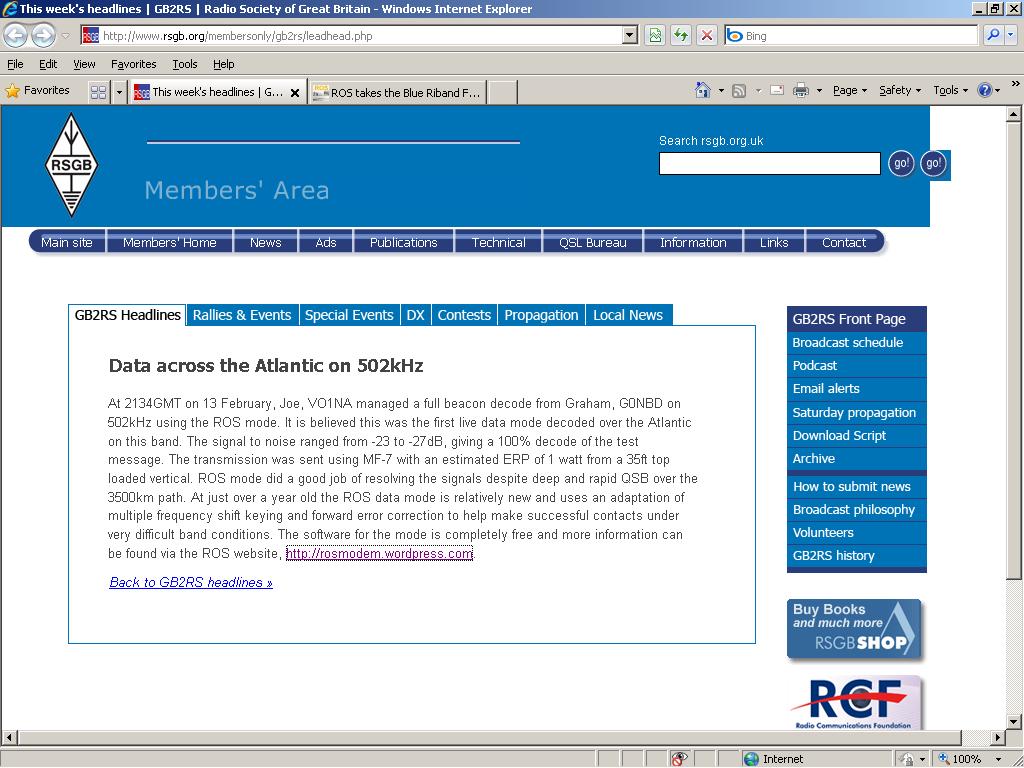
February: Transatlantic digital on 500 kHz as reported by
RSGB news
Thanks to Graham,
G0NBD for his patience and generous assistance and to MRCN
for the use of the receiver.
January A third report is sent to RAC.
Running 100 watts to a 100m wire at 15 m height. 13-15 Jan 2011. Clear ARGO traces were received by PA3CPM and PA3FNY. 16 Weak copy by PA3FNY who was receiving XGJ on 137 kHz very well. 17 PA3FNY reports traces. 18 PA3CPM copies in QRM. Good copy at PA3FNY. 19 Audible at PA3FNY. VE7BDQ reports weak traces and weakly heard at G3LDO. 20 Now QRSS3. Copied by PA3FNY on 21 and vy strong on 22 Jan. Copy By F4DTL on 22nd. Not detected by VE7BDQ on either day. 23 Good copies by PA3FNY and G4WGT. 24 Aerial iced and down. 25: US stations are authorised to use 461-487 kHz.
Operation Schedule / Signal Reports 2010
Sept 2010. Reports from KN1H KN8AZN VO1VCE. Off air following major storm on 21 Sep. QRV again on 507.77 kHz as of 2250 UTC 26 Sep. 2010. 28 Sept. Signal reports received from VO1FJS, VO1TA, VO1MP, VO1JNS, but nothing heard at VE1DM in Sydney NS. 30 Sep. Reports: VE1DM (heard 2304 UTC) VO1BQ.
Aug 2010. A follow-up report is sent to RAC.
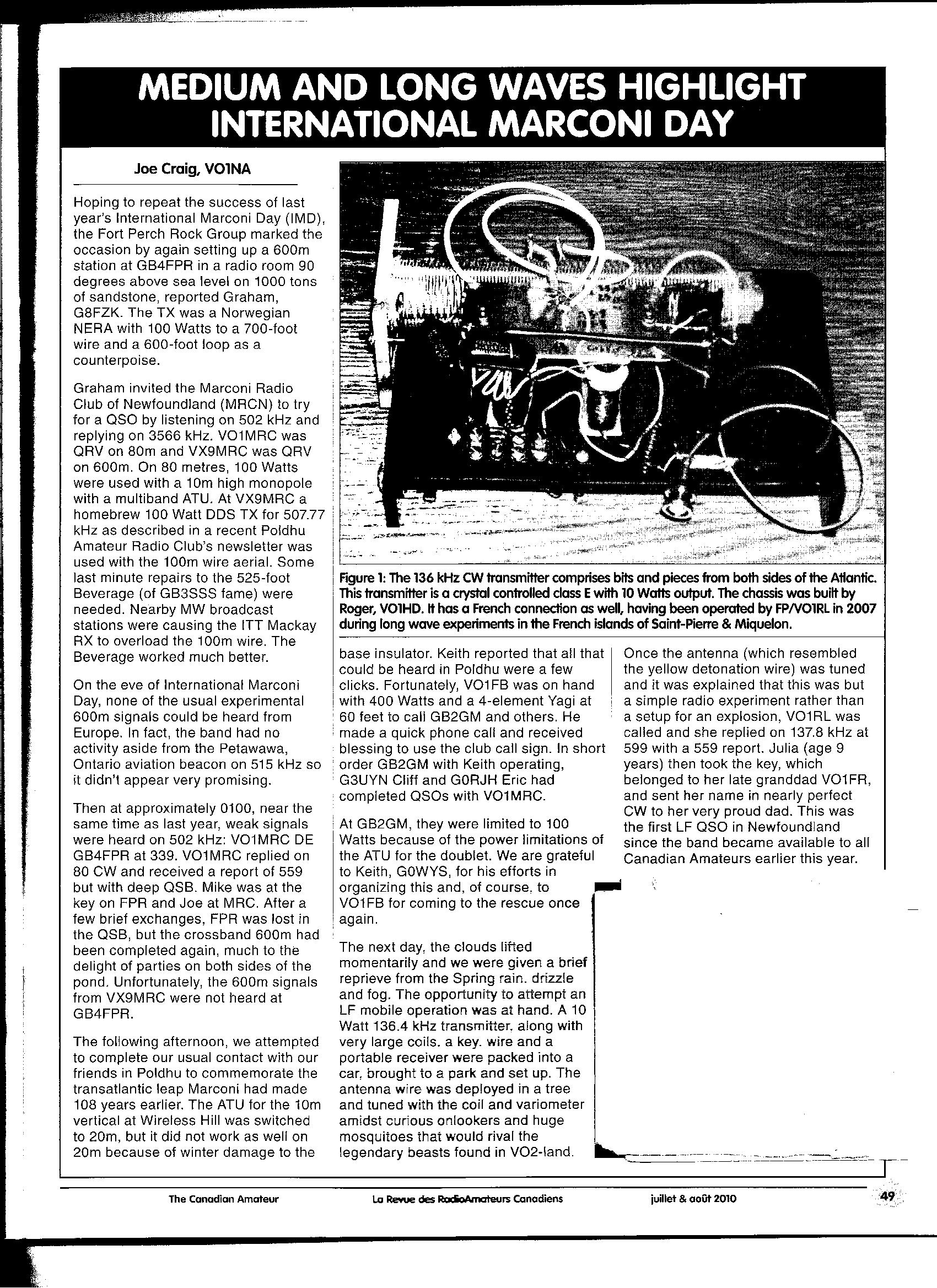
July: John Gibbs' report is published. See P 45 of the Jul/Aug 2010 issue of The Canadian Amateur (TCA) Alan Griffin, editor. Report on My Activities near 500 kHz. Also in that issue P 49 see a report on International Marconi Day. 10 July 0415 utc. VX9MRC on 507.77 kHz is heard (weak but readable) using an FT-817 and a PA0RDT miniwhip at 57 03N 61 18W off the Labrador Coast. TX 100 watts to 100m wire at 10 m height. May: 20th: The first transatlantic 500 kHz signals from PA3CPM are received.

23 VX9MRC is received by W1TAG in ME and at various locations
around NL.
March: VX9MRC renewed by Industry Canada.
January: 8 WPM CW 507.77 kHz 1.7 amps 100 watts. 100m wire at 10m.
Many reports received from Europe and North America.
The first local measurements of signal strength are made by
Jim VO1YR.
Operation Schedule / Signal Reports 2009
23 Oct 2009. VX9MRC commissioned. Copied by VO1HP VO1XP VO1FB
More info to appear soon. Also copied by VO1NA at breakfast meeting
inside a restaurant with a PA0RDT miniwhip and curious onlookers.
25 Oct. QSO with EI0CF. First Canadian 600m experimental transatlantic QSO.
Copied by VE1VDM (argo).
Copied by VO1GXG 'As clear as day'
03 November. QSO with Jack VX9ZZZ. DI2AM WE2XSH/6 heard. 2338 beacon
started on 507.77 kHz
reports from VE2PEP (nil today) SM6BHZ and DL8AAM
7 Nov QRSS3 507.77 kHz. Reports from AA1A 'Nice crisp QRSS3 beacon...'
And an ARGO copy by VE7BDQ, spanning Canada, QRB=5000 km.

John was using a shielded 3 metre loop in a NE/SW orientation
fed with coax and using a shielded preamp/tuner in the shack which feeds a
Icom pro3 in cw mode set at 350 cycle bandwidth.
Reports of QRSS3 and CW reception received from Germain, VE2PEP 2235,0343.
8 Nov QRSS3 507.77 kHz. Reports from VE2PEP and QRSS3 fragments
received at VE7BDQ at 0806 and 0808 utc. Norway amateurs are allocated
a band at 493-510 kHz on 6 November. Copied by GM3BST at 339 at 2240.
9: QSO with G3LDO using QRSS3. Another CW qso with VX9ZZZ.
Report from VE2PEP Copied QRSS. 0030, 0430.
10 Nov 2220 UTC. Reports from VO1SJH(Port au Port, weak),
VO1UL(St. Anthony, clear) and VO1TA (very close! weak but readable).
Reports were sent from these stations on 3738 kHz where conditions were
poor and QRM was high.
November 2009. A report is sent to RAC. In an unfortunate turn of events, RAC is advised by IC that there may be no provisions for Canadian 500 kHz experimental stations to communicate with other stations. Not withstanding that communication between amateur and other experimental stations was explicitly included in the officially approved experimental proposal, for the purpose of "exchanging signal reports and comparing propagation" further communications from VX9MRC are henceforth voluntarily suspended pending further information.
09 December 2009: 2200-2300 UTC and 10 December 0100-1000 utc CW 507.77 kHz. Reports will be posted at a later date.
Historic note: 13 November 2007 first amateur transatlantic QSO. GI4DPS and WE2XGR/1 (K2ORS Warren), 2xCW ~500 kHz.
Audio clip from VO1HP 23 Oct 09 on 507.77 kHz
Audio clip of the ei0cf vx9mrc QSO